
Wednesday, 22 Jul 2026 • 12 min read
The Lost Ark: Eight years in the making

Ivan Vladimirov
@ivan.vladimirov.graphic
Before I start, this is not a paid promotion. Teorema is not a Keyhowl client at the time of writing, nobody asked me to publish this, and I do not gain anything from praising the game. This is simply my personal opinion after playing something that I have been waiting to experience for a very long time.
Some of you who have been in the escape room business for longer probably already know Teorema. Their first game, Atlantis, is almost ten years old and has been a TERPECA finalist six times. Nowadays, of course, there are bigger and technically more advanced games, but Atlantis still holds up incredibly well. I have played it a few times, and it remains one of the most decent adventure rooms in Eastern Europe. It also has special effects and puzzle ideas that I have still not seen anywhere else, despite playing hundreds of rooms around Europe.
But this post is not about Atlantis.
Ten years later, Teorema finally has another game: The Lost Ark. The newest room in Sofia, Bulgaria.
It is an adventure again, but after playing it, simply calling it an “adventure escape room” does not feel right anymore.
I Thought Escape Theater Was the Next Big Step
A few months ago, I wrote about the evolution of horror escape rooms and the rise of escape theater. For me, that was - and probably still is - one of the most interesting directions in which the industry is moving. Especially in Athens, rooms are becoming less like traditional puzzle games and more like complete theatrical productions. Actors have scripts, scenes have rhythm, and the player moves through something that feels much closer to a film or a live performance.
I thought this was what made the most sense as the next step for escape rooms. Horror has a natural advantage because an actor can react to you, control your attention and create a very personal feeling. After playing some of the best escape theater experiences, I honestly did not expect a game without a single actor inside to leave me speechless again.
But that is the strange thing about escape rooms. They are a world of feelings, and the reason one game stays in your mind for days, weeks or even months is deeply subjective. It could probably be studied in universities. Sometimes it is fear. Sometimes it is one perfect puzzle, the way the story develops, a moment of teamwork or something that you cannot properly explain afterwards.
For me, I thought it ended with horror but The Lost Ark proved me wrong.
Eight Years of Waiting
I first heard about this game around eight years ago. Yes, eight.
A new Teorema room had entered construction, and because I had already played Atlantis, I immediately thought those people were going to build something incredible. I expected it to be ready within the next few months, as you normally would.
A few months passed. Then a year. Then several years.
At some point, people started saying Teorema had stopped working on the room and that the project had been abandoned. Those turned out to be only rumours, but eventually most of us forgot about the game. Life went on, new rooms opened, old rooms closed, and the industry changed completely while this one game was still somewhere in construction.
Around a year ago, our paths crossed again and we met for a quick chat. That was when I learned that the rumours had been wrong. And not just slightly wrong - they were unbelievably wrong. Teorema had never stopped building. Not for a single day...
They invited me to the new location, and the moment I entered the lobby, I knew this was not going to be a normal game. The room itself was still not finished after seven years, but the building around it already showed exactly what kind of people were creating it.
I do not think there is another escape room venue where this much attention has been given to every single corner. I am not even talking about the game yet. I mean the lobby, the corridors, the bar, the party centre and, somehow, even the damn bathrooms.
Everything the owners have touched looks like a separate piece of art. When I first entered the bathroom, I pulled out my phone-not to take a mirror selfie, but to film the room. To get soap, you put your hand inside a hand-carved gargoyle. The toilet has been integrated into the decoration so thoroughly that my furniture at home feels less special. Even the bathroom door is a real arched wooden-and-metal door that probably weighs more than 50 kilograms.
There is a second bathroom as well, and I am not going to describe it. You will have to see that one yourself.
It might sound ridiculous to spend this much time talking about toilets in a review of an escape room, but it tells you everything you need to know about Teorema. Most companies would focus their budget on the parts players see during the actual game. A hallway can remain a hallway. A bathroom can remain a bathroom.
Teorema seems unable to accept that anything should be ordinary.
This Was Not Built as a Sensible Business
You have probably already guessed this, but The Lost Ark was not created as a normal revenue-first business project. At least, I cannot look at it and believe that the main goal was to make the numbers work as efficiently as possible.
No sane person decides to spend eight years constructing one escape room if the only goal is to generate revenue. From a business perspective, it makes absolutely no sense. During those eight years, the owners could have opened several smaller games, started earning money much earlier and avoided a ridiculous amount of work, risk and stress.
Instead, they kept building one thing.
That is what makes the place feel different. You can see that it was created for the player and for the experience that player will have. Decisions do not appear to have been made because something was cheaper, faster or “good enough.” They were made because the owners wanted the world to feel real.
The eight-year construction period is probably the strongest proof of that. This game does not feel like a product that was prepared for the market. It feels like something its creators needed to finish properly, regardless of whether doing so was financially reasonable.
I am not saying businesses should ignore money. Obviously, escape room owners need to survive, pay their staff and recover what they invest. But occasionally, you enter a place where you can immediately see that the calculation was not the starting point.
The player was.
Expectations Can Destroy a Game
Several more months passed after my visit before I was finally invited to play. By that point, my expectations were extremely high, which is usually dangerous.
Most experienced players know this feeling. You hear about a game for years. Everyone says it is revolutionary. You travel specifically to play it, already carrying a perfect version of the room inside your head, and then the actual experience cannot possibly compete with what you imagined.
The game might still be good, but it feels smaller than the expectation.
For the first time, that did not happen to me.
I expected a lot from The Lost Ark, and I received it. It was a breath of fresh air after a period in which I had not played many rooms, and it reminded me why I became so obsessed with this industry in the first place.
I keep calling it an escape room because that is technically what it is, but for players like me, I do not think that is how it will be remembered. It is simply an adventure.
You Do Not Follow Indiana Jones. You Become Him.
I have played a lot of games described as adventures: ancient temples, lost cities, archaeologists, hidden artefacts, mysterious expeditions and every possible variation of the Indiana Jones formula.
Many of them are great, but usually you are following the adventure of somebody else. You find the explorer’s notes, solve the mechanisms they left behind and slowly discover what happened before you arrived. You are involved, but you are still following the main character.
The Lost Ark changes your position completely.
You genuinely feel like Indiana Jones. You are not reading about an expedition or helping a fictional archaeologist finish one. You are physically inside it. You move through the world, take risks, make decisions, work with your team and deal with the consequences of what you do.
You are the main character.
That is why I think this game almost creates a genre of its own. Calling it an adventure room is technically correct, but it puts it beside hundreds of other games that create a completely different feeling. “Immersive experience” is also too broad and has been used to describe almost everything by now.
The closest description I can think of is a first-person adventure.
The important part is not only that the world looks realistic. The game gives you something meaningful to do inside that world. You are not standing in front of impressive decoration while solving disconnected puzzles. The actions themselves create the adventure.
And all of this happens without an actor.
The Environment Is the Game
I cannot describe specific locations or moments without spoiling the experience, but I need to talk about the construction.
I have played around Europe and visited many of the top TERPECA rooms. I have seen huge sets, moving structures, real vehicles, fire, water and all kinds of effects that make you ask how somebody managed to build them.
The scale of The Lost Ark is impressive, but scale is not what makes it special. The realism does.
If something looks like metal, it is metal. If it looks like rock, it is rock. Wood is wood, brick is brick and cast iron is cast iron. It is like that everywhere.
I touched as many walls, props and corners as possible because that is usually where the illusion falls apart. Something looks like stone until you touch it and realise it is foam. A giant wooden structure sounds hollow. A piece of ancient machinery turns out to be lightweight plastic.
I could not find that moment here.
There was also nothing that pulled me out of the story. No visible cable, badly positioned camera or random prop that clearly came from somebody’s storage because they did not want to throw it away. Everything felt like it belonged exactly where it had been placed.
That kind of realism changes the way you behave as a player. You stop treating the environment like decoration around a puzzle. Heavy things feel heavy, rough things feel rough, and the place reacts like the real location your eyes believe it to be.
The decoration is not sitting around the game.
The decoration is the game.
It Is Not a Traditional Puzzle Room
You still need to think, but The Lost Ark is not built around traditional puzzles in the usual sense. Most of the time, you understand what needs to happen. The challenge is actually completing it.
The experience is much more physical and action-based. That does not mean it is simply an obstacle course. It means the interactions belong naturally inside the story. You are not repeatedly stopping the adventure to solve a code or open another padlock. What you are doing is the adventure.
Teamwork is also one of the strongest parts of the game. You need a minimum of four players, and this is not the usual recommendation companies make because having more people helps you search faster.
You genuinely need everyone.
Each person has a role, each person gets their own moments, and there are situations in which the team depends on every member doing their part. Many non-linear rooms separate players by giving everyone a different puzzle to solve, but that can sometimes feel like four people playing separate games inside the same building.
Here, you can have different responsibilities while still feeling like one team. Everything is connected to the same shared objective.
The game is also non-linear in a more interesting way than simply placing several puzzles in front of you at the same time. You can approach things differently, and there is not always one correct way to play. Sometimes you understand afterwards that you could have made something easier by waiting or making another decision.
Naturally, I was the first person to do something stupid.
In the end, that became part of our version of the adventure. Another team could complete the same game and leave with a different story, which is much more interesting to me than comparing completion times.
Do Not Waste It by Playing for the Record
Playing this game as quickly as possible makes very little sense.
Sure, you can chase a record and try to use the fastest approach, but the biggest cost is not that you might get wet. The cost is that you have to leave the place sooner.
You will want to stay inside.
Even when you already understand what needs to be done, many of the actions physically require time. Knowing the answers does not allow you to suddenly rush through everything. This is also why I am planning to play again next month. I do not expect to be much faster, and I do not want to be.
Some escape rooms depend almost entirely on surprise. Once you know the solutions, much of the experience disappears. The Lost Ark has surprises, of course, but it is also about participation. Knowing what happens does not mean you have finished experiencing it.
The owners also tell everyone to bring spare clothes and shoes. I normally do not trust owners when they say something like this, because it often means there is a one-square-metre pool with five centimetres of water and one person might get a slightly wet sock.
That is not the case here.
I will not explain more because I do not want to spoil anything. Just take the spare clothes.
To be clear, I finished completely dry, despite doing most of the things that could be considered dangerous. You can avoid getting wet if you are careful, but the warning is real. Your choices matter, and sometimes you realise a little too late that waiting could have made things easier.
Again, I was dry. I just want that officially recorded.
Why I Am Writing About One Game
I normally do not plan to write this much about individual escape rooms. There are many great games, personal taste is subjective, and a dedicated post can very easily start sounding like paid promotion even when it is not.
This one deserves an exception.
Other experienced players have already shared similar reactions. Natasa Potocnik from Enigmarium loved the game, and TERPECA ambassador Nadezhda Danabasheva also published a long and extremely positive review. Everyone will naturally react differently, but I am clearly not the only person who came out feeling that Teorema had created something unusual.
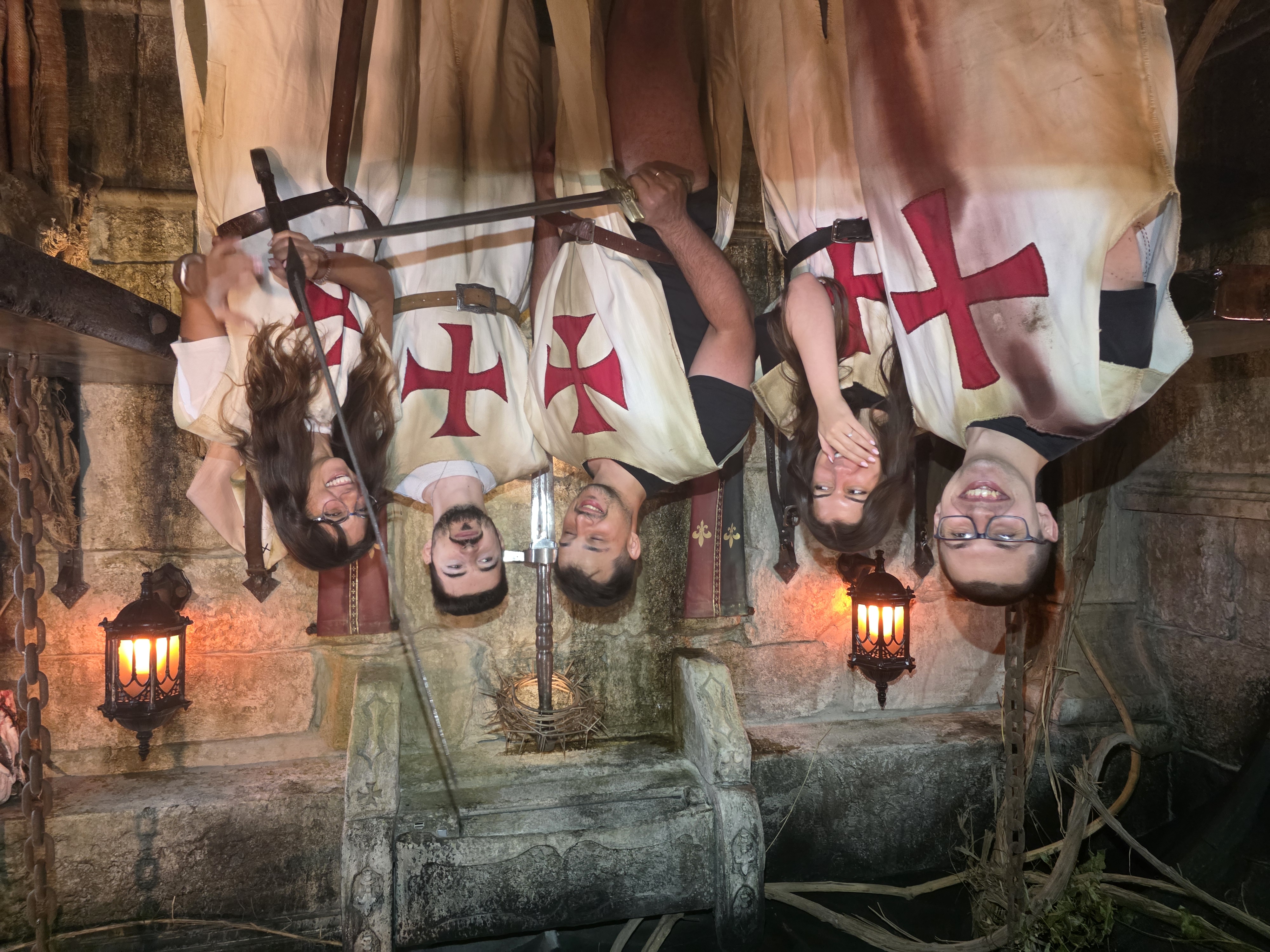
The Lost Ark did not stay with me because of one puzzle, one effect or one impressive room. It stayed with me because of the complete feeling it created. For a few hours, I was not a customer moving through an escape room. I was inside an expedition, and my team was responsible for completing it.
After playing hundreds of games, it becomes harder to experience that. You start recognising the structures behind everything. You know where the cameras are likely to be, what kind of mechanism is probably behind the wall and when the next transition is coming. The more you understand how rooms are built, the easier it becomes to see the wiring.
The Lost Ark made me stop looking for it.
Eight Years Suddenly Makes Sense
Eight years is an insane amount of time to spend building one escape room. No one in their sane state would choose that path if efficiency and profit were the only priorities.
But once you enter the venue, look at the materials, notice the details and experience how everything works together, those eight years begin to make a strange kind of sense.
Teorema did not spend them trying to make the largest room or to fill the game with as many effects as possible. They spent them creating a place where almost nothing feels fake, nothing feels accidental and every player matters.
Atlantis showed almost ten years ago that Teorema could build ideas people would remember. The Lost Ark proves they did not spend the years afterwards standing still.
Mark my words: Teorema will be recognised again, and it will be deserved.
I waited years to play this game, and it did not disappoint me. For the first time, the reality was not smaller than the expectations I had built in my head. I have played many adventure rooms and I have never played an adventure like this one.
With a hand on my heart I can simply say that this is the best game that I have ever played up to this day.
P.S. If you’ve made it this far, chances are you’d like to play the game yourself! Teorema’s new website is coming soon, and online bookings are expected to open around mid-August. In the meantime, if you’d like to learn more or book in advance, send them a message on their Facebook page-they’ll be happy to help.